


 Red wine
 White wine
 Rosé wine
 Primeurs
 Sherry and Port wine
 Sweet wine
 Orange wine
 Vermouth
 Champagne
 Cava
Cava Prosecco
 Lambrusco
 Crémant
 Moscato d'Asti
 Franciacorta
 Pet-Nat
 Corpinnat
 Other sparkling wines
 Rhum
Rhum Gin
Gin Whisky
 Vodka
Vodka Cognac
 Brandy
 Pastis
 Tequila
 Mezcal
 Grappa and Eau de vie
 Calvados
 Liqueurs
 Pacharán
 Apéritifs
 Wine gift boxes
 Boxed wines
 Boxed sparkling wines
 Wine bottles and glasses
 Gift card
 Non alcoholic Wine
 Non alcoholic Sparkling wine
 Non alcoholic Gin
 Other non-alcoholic drinks
 Aromas
 Wine conservation
 Decanters and aerators
 Bottle identifiers
 Corkscrews
 Service
 Glass identifiers
 Cleaners
 Accessories set
 Wine glasses
 Contact

The Art of Pairing: More Intuition Than Science
Whenever we discuss wine pairing, the conversation often sparks some controversy. We find it challenging to agree on the perfect combination for each dish. The first thing we must understand is that pairing is not an exact science. We are not dealing with mathematical formulas or foolproof recipes. There is no single correct way to pair wine and food.
We can perceive pairing as the pursuit of a harmonious relationship between the dish and the accompanying wine. Some even refer to it as a "marriage" between the two. But here arises the first dilemma: what does pairing truly mean? Are we talking about harmony or contrast? Because, as in any relationship, some pairs complement each other gently, while others stand out for their contrast. Let's leave that debate open and focus on what interests us: wines and their ability to accompany food.
Where do we begin?
The first step is to establish a logical order when serving wines, just as we follow a sequence with dishes: we start with light appetisers, proceed with the main course, and conclude with dessert. The same principle should apply to wines: begin with the lighter ones and gradually increase in body and intensity. It would be a mistake to start with a robust red and finish with a fresh white, as the latter would be completely overshadowed.
A basic guideline might be as follows:
-
Young white or rosé wines,
-
Aged white or rosé wines,
-
Young reds,
-
Crianzas,
-
Reservas and Gran Reservas.
Another option is to be guided by the climate of origin: start with wines from cooler regions (with less ripeness) and move towards those from warmer climates (more structured).
Pairing comes into play
Once the order is defined, it's time to choose: do we harmonise, contrast, or complement? The most common approach is to seek harmony between the dish and the wine.
When we talk about fish
Seafood such as oysters, prawns, or shrimp pair excellently with dry white wines, preferably with saline notes, like Albariños or Atlantic whites from Galicia.
Grilled fish pairs well with young and simple whites. If the dish includes sauces or complex ingredients, we will need more elaborate wines: barrel-fermented whites or aged sparkling wines.
And what about fish with red wine? Absolutely, if that's your preference. However, opt for a light red with good acidity and low tannins. A Pinot Noir, a high-altitude Garnacha, or Atlantic reds from Galicia or the Canary Islands can work perfectly.
When we talk about meats
Here, it's advisable to distinguish:
-
White meats can pair with full-bodied whites or complex rosés.
-
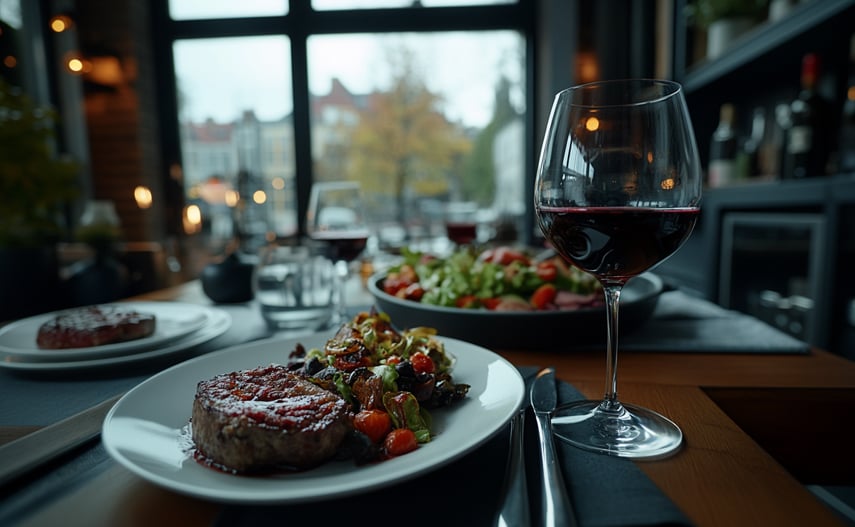
Red meats require more structure. For grilled meat, a crianza red from Rioja or Ribera del Duero will be a great ally.
-
Stews, casseroles, or game demand intense wines with personality. A Priorat, a Toro, or even an Amontillado can elevate the dish to another level.
The sweet moment
Dessert arrives. If it's fruit-based, a sparkling wine can help cleanse the palate and balance the acidity. For cream or custard cakes, nothing beats a well-balanced sweet wine. And if we're talking about dark chocolate, the ideal choice is a wine with structure, vibrant acidity, and a certain complexity.
The geographical pairing trick
A recommendation that rarely fails is to pair wines and dishes from the same region. It makes sense: for centuries, local food has been accompanied by the wine of the area, and that tradition is no coincidence. Galicia, for instance, offers seafood and wines that seem made for each other.
At Decántalo, we have prepared a Practical Pairing Guide to help you pair wines and dishes in a simple, clear... and delicious way!
View this post on Instagram